
Flex Connect: People at the Heart of Progress
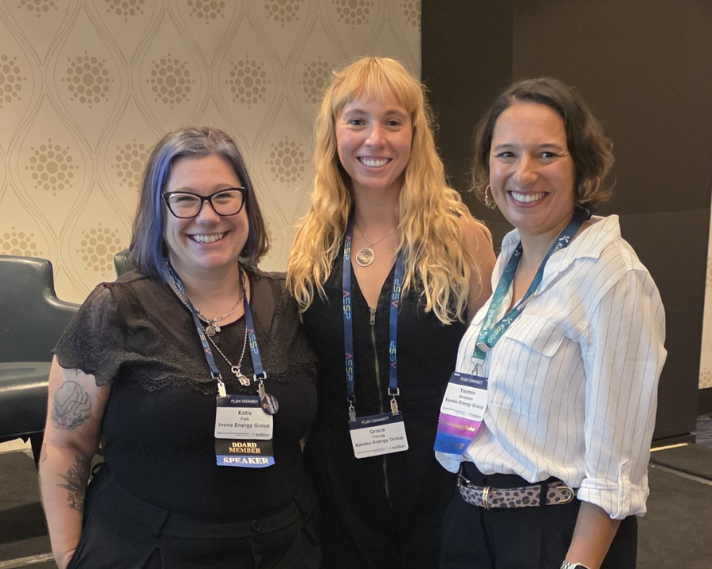
Katie Falk with Grace Young and Yasmin Abraham of Kambo Energy Group
My biggest takeaway from AESP Flex Connect 2026 is simple: people are still at the heart of progress.
We've made tremendous advances in technology, program design, and the capabilities needed to enable demand flexibility. The infrastructure is advancing. The solutions exist. Yet there is still significant work to do in creating compelling customer value propositions and driving meaningful engagement.
That reality became especially clear during the session I facilitated alongside Kambo Energy Group.
During our interactive, learning lab session, each table was assigned a customer segment and asked to identify its goals, barriers, potential partnerships, value propositions, and pathways for progress. As participants worked through the exercise, a common theme emerged. Throughout the room, I heard comments like:
“This group seems too broad.”
“We're making a lot of assumptions here.”
“This planning is difficult without having conversations.”
Exactly.
What struck me was that the groups, by design, were somewhat specific. Participants were assigned customer segments such as income-qualified households, older adults aging in place, non-English-speaking customers, rural residents, renters, and urban Indigenous communities.
It made me wonder how many demand flexibility programs segment their customers with even this level of specificity. If we're still struggling with customer engagement across the industry, perhaps it's because we haven't yet gone deep enough in understanding the people we're trying to serve.
Demand flexibility presents a different challenge than traditional energy efficiency programs. The value propositions aren't always the same, and neither are the barriers to participation. While financial savings may still matter, awareness and understanding are often the first hurdles to overcome.
At the same time, demand flexibility offers benefits that can resonate strongly with specific communities. The opportunity to contribute to fewer power outages, a more resilient grid, cleaner energy, and improved air quality can be powerful motivators, particularly among groups that place a high value on collective or community benefit.
The potential is enormous. But realizing that potential will require us to move beyond assumptions and broad customer categories. It starts with listening, having conversations, and understanding what matters to people before asking them to participate.
After all, demand flexibility may be powered by technology, but its success ultimately depends on people.